
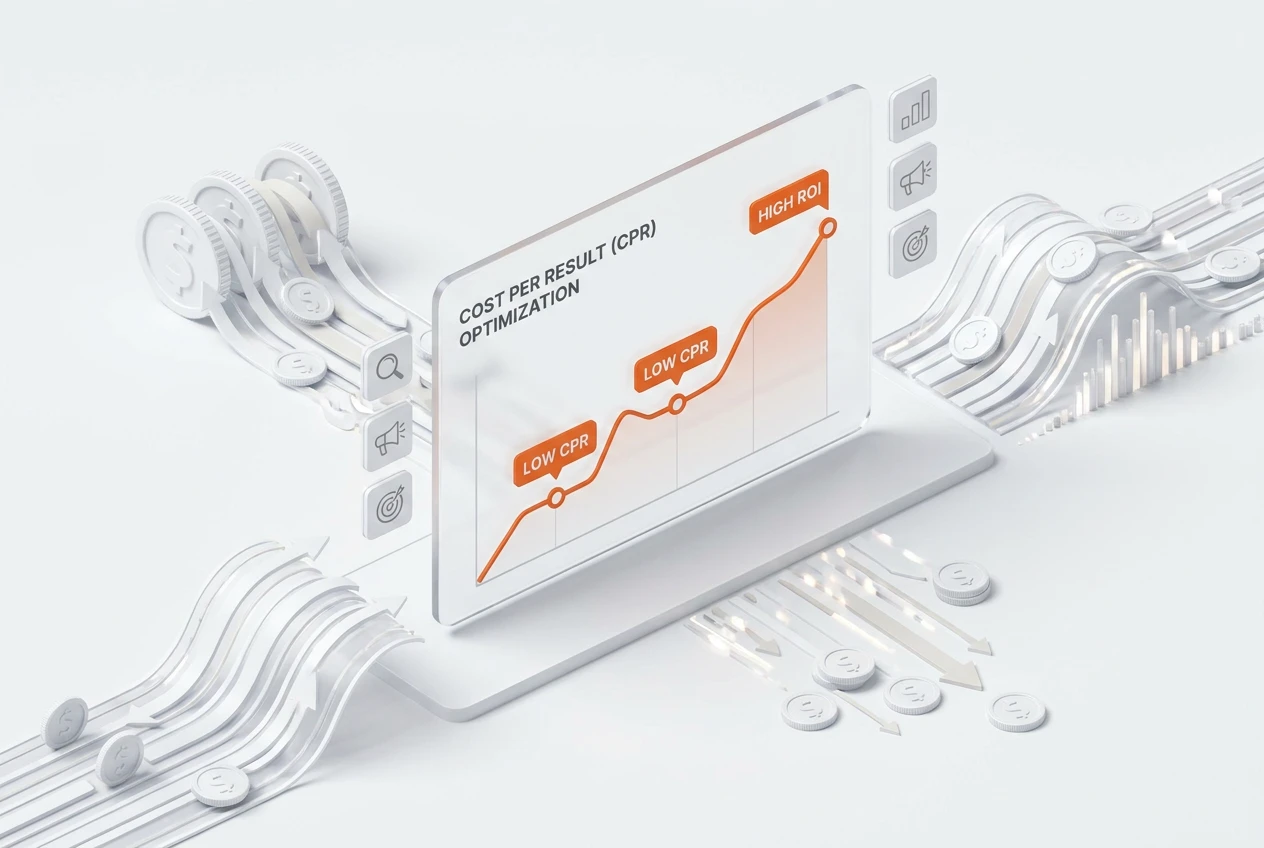
To optimize your advertising ROI, focus on the quality of your ad design and precise audience targeting. Conduct ongoing A/B tests on headlines, copy, and images. Additionally, ensure your landing page aligns with your ad’s message for a seamless user experience. This approach drives conversions and reduces the cost per desired action—something we excel at at Boom Media as a Meta Certified Partner.
What is Cost Per Result (CPR) in Advertising?
Cost Per Result (CPR) is a key metric in the world of paid digital marketing. Simply put, it is the average cost you pay for each specific action a user takes as a result of your ad. For example, this action could be a purchase, filling out a form, or downloading an app. As a result, this metric helps you understand the true return on your advertising investment (ROAS) directly and clearly.
Why is Cost Per Result (CPR) more important than Cost Per Click (CPC)?
While cost per click (CPC) measures the price of each click on your ad, cost per result (CPR) focuses on the ultimate goal. You might get thousands of clicks at a low cost, but if they don’t lead to conversions, they don’t deliver real value to your business. Therefore, cost per result is a more strategic metric. It directly links your ad spend to business goals, allowing you to optimize ad campaigns to maximize profits.
How is Cost Per Result calculated in advertising?
Calculating CPR is simple and straightforward. The formula is: total amount spent on the ad campaign divided by the total number of results achieved. For example, if you spent $100 on an ad campaign on Meta platforms and received 20 sign-ups, the cost per result is $5. This figure gives you a clear picture of the efficiency of your spending and the effectiveness of your ads.
What are the main factors that affect the cost per result?
The cost per result in advertising is influenced by several variables. First, audience targeting plays the biggest role; the more precise your targeting, the lower the cost. Furthermore, the quality of the ad’s design and message directly impacts user engagement. Market competition and the time of year (seasonality) can also drive up costs. Finally, the landing page users reach after clicking on the ad is a crucial factor in completing the conversion.

How can you optimize ad campaigns to reduce costs?
To optimize your ad campaigns and reduce costs, you must adopt a data-driven approach. Start by conducting continuous A/B tests on different elements of your ad, such as images, copy, headlines, and even calls to action (CTAs). Use Custom Audiences and Lookalike Audiences to reach the people most likely to convert. Additionally, regularly analyze ad performance and eliminate underperforming placements or designs. This continuous optimization is the key to success.
What are the best practices for Meta-funded ad campaigns?
To achieve the best results on Meta platforms (Facebook and Instagram), there are several best practices to follow. First, clearly define your campaign objective from the start, whether it’s to increase awareness or drive sales. Second, invest in high-quality visual content tailored to each platform. Third, ensure your landing page is mobile-friendly and loads quickly. Finally, use the conversion tracking feature (Meta Pixel) to accurately measure results and optimize your future targeting. These are some of the best practices for paid advertising campaigns.
What role does ad quality play in determining the cost of results?
Ad quality plays a pivotal role in determining the cost of results. Meta’s algorithms prioritize ads that provide a positive user experience. Relevant and engaging ads receive higher quality scores, leading to lower cost per impression and reaching a wider audience with the same budget. Conversely, low-quality or intrusive ads face higher costs and may have their display restricted. Therefore, investing in creative design and a clear message is not a luxury, but a necessity for reducing costs.
What are effective strategies for reducing ad costs?
To effectively reduce your ad costs, you can implement several proven strategies. Here are the most important ones:
- Improve targeting: Narrow your audience to focus on segments most interested in your product or service.
- A/B testing: Continuously test ad variables (images, text, call-to-action) to identify the best performers.
- Improve Quality Scores: Create ads that are engaging and relevant to your audience to improve the platform’s evaluation of your ad.
- Use retargeting: Target users who have previously interacted with your brand, as they are more likely to convert.
- Optimize your landing page: Ensure your landing page provides a seamless, fast experience that aligns with your ad’s message.
- Set your budget wisely: Use automated bidding strategies to allow the platform to optimize spending for the best results.
Why do you need a Meta-certified partner like Boom Media?
Working with a Meta Certified Partner like Boom Media gives you a significant competitive advantage. As certified partners, we have direct access to advanced technical support from Meta, as well as specialized training on the latest tools and strategies. This means your campaigns are managed by a team with the knowledge and expertise to analyze ad performance and achieve the best cost per result. We don’t just manage your ads; we build a sustainable growth strategy for your business backed by accurate data and over 9 years of experience.
Frequently Asked Questions
What is the difference between CPR and CPA?
Cost Per Result (CPR) is a broader term that can be applied to any objective (such as a video view), while Cost Per Acquisition (CPA) typically focuses on acquiring a new customer or making a sale.
Does Cost Per Result apply to all types of ads?
Yes, the concept of cost per result can be applied to any advertising campaign with a measurable goal, whether on social media platforms, search engines, or any other paid digital marketing channel.
How often should I monitor the cost of results in my campaigns?
You should monitor the cost of results daily during the first few days of the campaign launch to make quick adjustments. After that, a weekly review may be sufficient to track performance and make strategic decisions.
Is a low cost per result always a good thing?
Not necessarily. A very low cost per result may indicate that you’re targeting a very broad audience or that the results you’re achieving aren’t of high quality. The goal is to strike a balance between a reasonable cost and results that deliver real value to your business.
How does Boom Media help improve cost per conversion?
At Boom Media, we use our expertise as a Meta Certified Partner to deeply analyze your campaign data, identify opportunities for improvement, and implement advanced testing strategies. We focus on every detail, from precise targeting to optimizing ad and landing page design, to ensure you achieve the best return on your investment.
In conclusion, understanding and optimizing the cost of results in advertising is the cornerstone of any successful paid digital marketing strategy. Instead of focusing on superficial metrics, this metric allows you to make smart decisions that drive your business growth. If you’re ready to turn your ad spend into real, tangible results, the Boom Media team is here to help. Contact us today or follow us on Facebook to learn more.