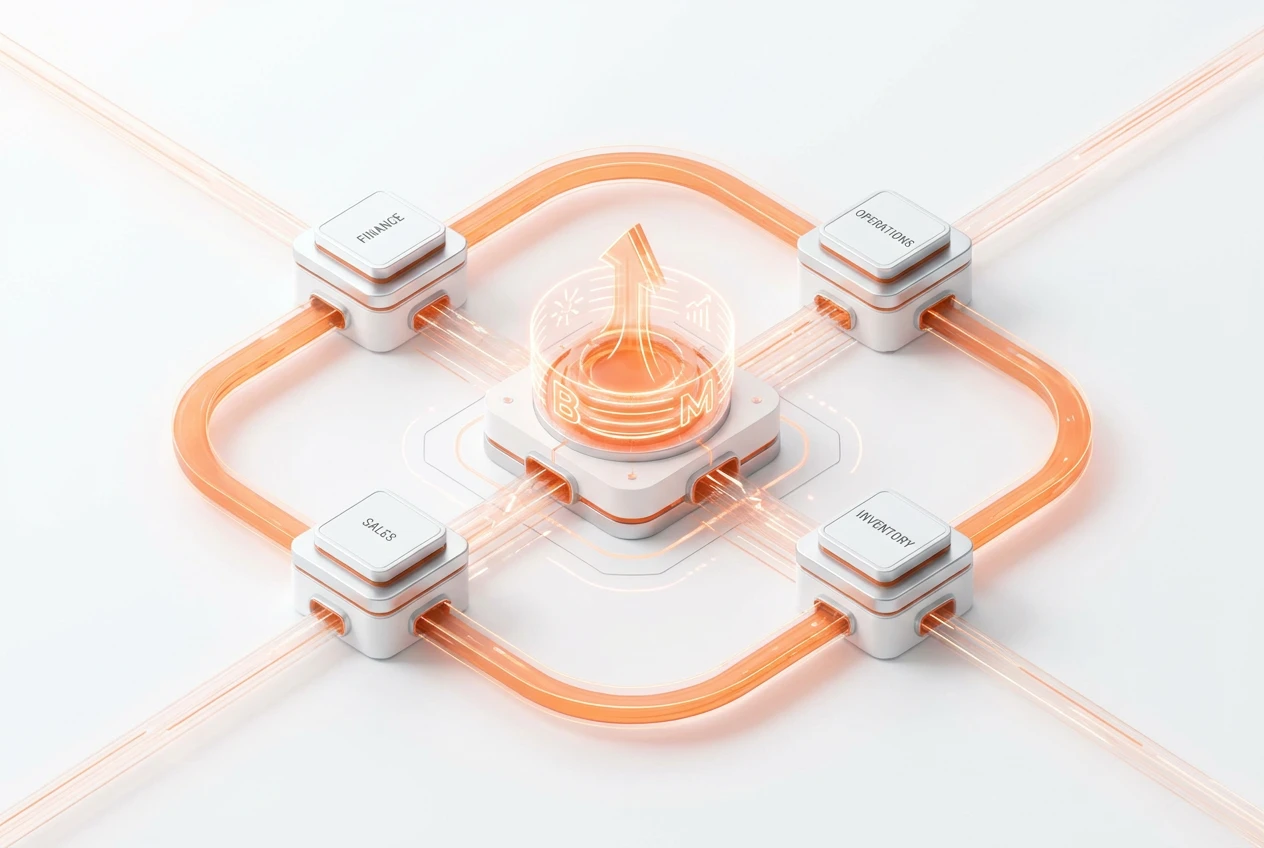
The competitive advantage of an ERP system lies in its ability to unify your company’s data and processes on a single platform. An ERP system gives you a comprehensive view of inventory, sales, and finances, enabling faster and more accurate decision-making. Consequently, this enhances operational efficiency, reduces errors, and improves the customer experience, giving you a competitive edge over your rivals and significantly driving your business growth.
What is an Enterprise Resource Planning (ERP) system?
An Enterprise Resource Planning (ERP) system is an integrated software solution for managing a company’s key business operations in real time. This system consolidates all company functions—such as finance, human resources, manufacturing, and supply chain—into a single database. As a result, it provides the company with a unified view of all its operations. This integration eliminates data silos and ensures a seamless flow of information between different departments.
How does an ERP system enhance operational efficiency?
An ERP system automates repetitive tasks and streamlines complex processes, significantly increasing operational efficiency. For example, it can automate order entry, invoicing, and payroll processing. Consequently, this reduces human error and saves employees valuable time. Employees can now focus on value-added tasks rather than routine administrative work, thereby boosting the company’s overall productivity.
What role does data analysis play in achieving the competitive advantage of an ERP system?
The core of an ERP system’s competitive advantage lies in its ability to provide integrated data analysis. The system collects data from all departments and presents it in easy-to-understand dashboards and reports. Consequently, managers can make strategic decisions based on accurate and up-to-date insights. This capability enables companies to identify trends, forecast demand, and proactively improve performance rather than reacting to events.
Can an ERP system improve customer relationship management (CRM)?
Yes, definitely. Many modern ERP systems include customer relationship management (CRM) modules or integrate seamlessly with them. This integration gives you a comprehensive view of each customer, from the first interaction through to post-sales support. In addition, you can track purchase histories and customer preferences and respond quickly to their needs. As a result, this leads to improved customer satisfaction and loyalty, which is a critical factor for success.
How does ERP help improve inventory and supply chain management?
Improved inventory management is one of the greatest benefits of ERP systems. The system provides real-time inventory tracking across multiple locations, preventing stockouts or overstocking. Furthermore, advanced forecasting tools help predict future demand and plan purchases accurately. This ensures you have the right products at the right time, reducing storage costs and improving cash flow.
What is the direct financial benefit of implementing an ERP system?
The financial benefit is clear and direct. By improving efficiency and reducing errors, an ERP system significantly lowers operating costs. For example, improved inventory management reduces carrying costs, while process automation lowers labor costs. In addition, accurate financial insights provide better control over the budget and cash flow. All of these factors contribute to increased profit margins and a strong return on investment.
Are ERP systems suitable for small and medium-sized businesses?
In the past, ERP systems were limited to large companies due to their cost and complexity. But today, the situation has changed completely. With the advent of cloud-based solutions, ERP systems have become accessible and affordable for small and medium-sized businesses. These systems are scalable, meaning they can grow as your business grows. Therefore, size is no longer a barrier to reaping the benefits of an ERP system for small and medium-sized businesses.
How Can You Use an ERP System to Outperform Your Competitors?
To outperform competitors, you must use an ERP system as a strategic tool, not just an operational one. Use the data generated by the system to gain a deeper understanding of the market and identify new opportunities. For example, you can analyze sales data to identify the most profitable products or untapped markets. This allows you to allocate your resources more effectively and respond to market changes faster than your competitors.
- 360-Degree Comprehensive View: Get a unified view of all your operations, from finance to sales.
- Faster Decision-Making: Rely on real-time data to make informed decisions quickly.
- Improve the customer experience: Provide personalized and prompt service through a deeper understanding of your customers.
- Increased Efficiency: Automate routine tasks to reduce costs and human error.
- Greater flexibility: Adapt quickly to market changes and demand thanks to precise planning.
- Sustainable business growth: Build a strong, scalable foundation that supports future business growth.
At Boom Media, we recognize that technology is the key to growth. With over 8 years of experience, we help companies select and implement the right technology solutions. Follow us on Facebook to stay up to date on the latest trends.
Frequently Asked Questions
What is the main competitive advantage of an ERP system?
The main advantage is providing a unified and integrated view of all company data and processes. This allows for faster and smarter decision-making, which boosts efficiency and gives you an edge over competitors.
How long does it take to implement an ERP system?
Implementation time varies depending on the company’s size and the complexity of its operations. It can take anywhere from a few months to over a year. Cloud-based solutions are typically faster to implement.
Is an ERP system very expensive?
Costs vary significantly. Cloud-based solutions have become an affordable option for small and medium-sized businesses, with subscription-based pricing models instead of a large upfront investment.
What is the difference between ERP and CRM?
A CRM (Customer Relationship Management) system focuses on managing a company’s interactions with current and potential customers. ERP, on the other hand, is a broader system that integrates all of a company’s functions—including finance, inventory, and human resources—and may include a CRM module.
How do I choose the best ERP system to increase profits?
To identify the best ERP system for increasing profits, you must first define your business goals and key challenges. Look for a system that is tailored to your industry, scalable, and provides the analytical tools you need to drive growth. Consulting with experts like the Boom Media team can help you make the right decision.
Investing in an ERP system is an investment in your company’s future. It gives you the tools you need not only to compete, but to excel and lead the market. At Boom Media, as a certified Meta business partner, we help you achieve that excellence. Are you ready to turn your data into profits? Contact us today to explore our integrated services.