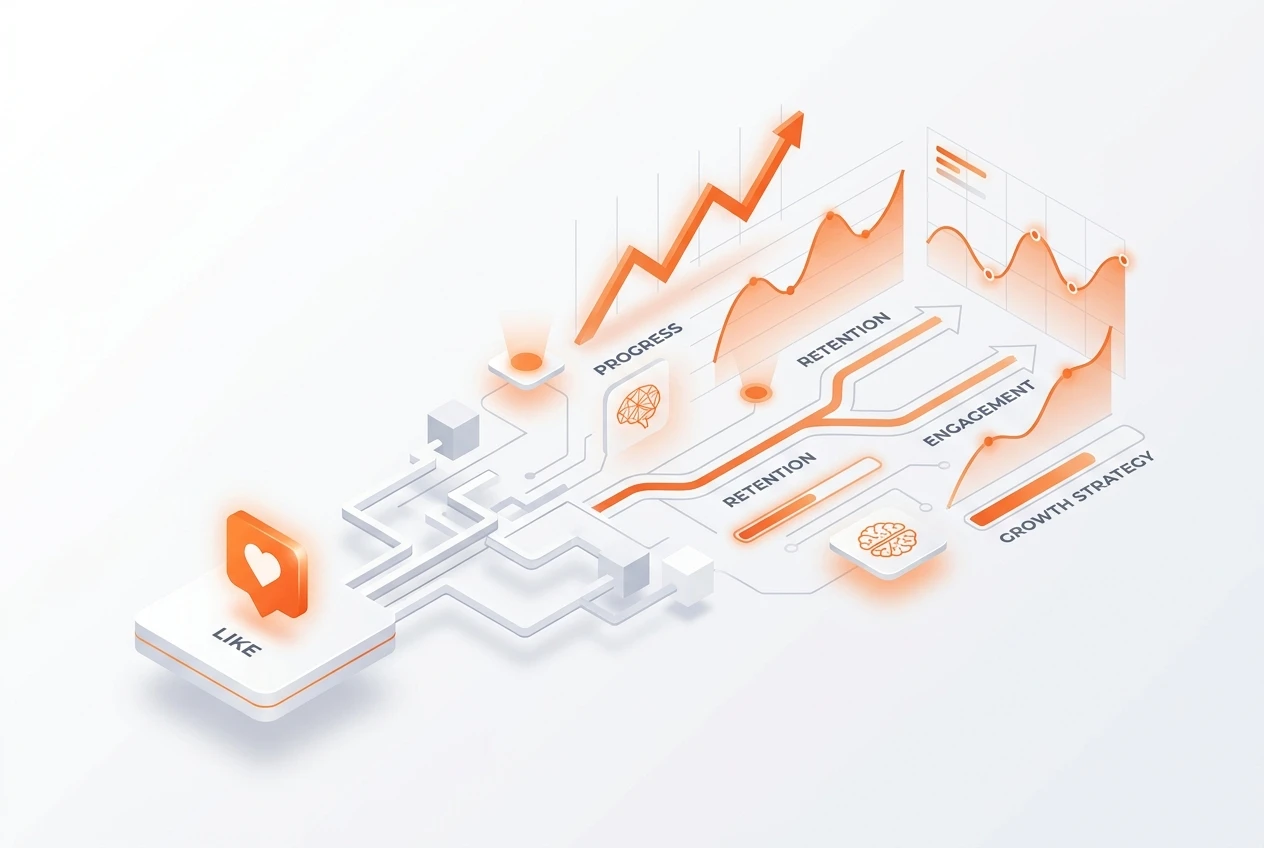
To measure true success, focus on key performance indicators (KPIs) that directly impact your business goals. Understanding the right social media metrics is key to growth. Instead of likes, track metrics such as customer acquisition cost (CAC), ad conversion rate, lifetime value (LTV), and return on ad spend (ROAS). This data provides clear insight into your investment’s performance and guides your future decisions to drive business growth.
Why are likes considered a misleading metric?
Likes and general comments may look good on the surface, but they rarely reflect the actual impact on your business goals. As a result, these metrics are known as “vanity metrics” because they don’t directly translate into sales or leads. Furthermore, they can be easily inflated without having any real value. Instead, social media data analysis should focus on metrics that show how your audience interacts with your brand in ways that lead to tangible results.
What are the most important KPIs to track?
Important metrics go beyond mere surface-level engagement. First, focus on reach and impressions to measure brand awareness. Second, track click-through rate (CTR) to understand how engaging your content is. Additionally, conversion rate is a critical metric for determining how many followers have become customers. Finally, don’t forget return on ad spend (ROAS) to measure the profitability of your paid campaigns directly.
How do you effectively measure brand awareness?
Measuring awareness requires looking beyond the number of followers. Start by tracking reach to see how many unique users viewed your content. Next, analyze impressions to understand how many times the content was displayed. It’s also important to monitor follower growth over time and compare it with competitors. When combined, this data provides a clearer picture of your brand’s reach in your target market.
What engagement metrics drive business growth?
True engagement is what drives users to take action. Instead of likes, focus on shares, which naturally expand your reach. Likewise, high-quality comments are a strong indicator of audience interest. Additionally, saves show that your content is useful and valuable to users. Consequently, these types of interactions signal the building of a loyal community around your brand, paving the way for increased customer loyalty and sales.

How do you link social media performance metrics to sales?
The direct link between social media activities and sales is the ultimate goal. You can achieve this by using tools like Meta Pixel to track referrals from your ads. Analyze the customer journey from the ad to the completion of the purchase. Furthermore, use UTM parameters in your links to accurately identify the sources of traffic and sales. Measuring the success of advertising campaigns in this way clearly demonstrates how your social media efforts contribute to your company’s bottom line.
What is Return on Ad Spend (ROAS) and how do you calculate it?
Return on Ad Spend (ROAS) is a vital metric that shows how much revenue you generated for every dollar spent on ads. Simply put, it is the most important performance indicator for digital marketing. To calculate it, divide the total revenue generated by the ad campaign by the total cost of that campaign. For example, if you spent $100 and generated $500 in sales, your Return on Advertising Spend is 5. This number gives you a clear understanding of the profitability of your advertising investment.
How can Boom Media help you analyze data?
At Boom Media, we don’t focus on vanity metrics. As a Meta Business Partner, we use our 8+ years of experience in social media data analysis to identify the metrics that drive real business growth. We help you optimize your return on Meta ads by tracking key performance indicators such as customer acquisition cost and return on investment. Our bilingual team is ready to develop a data-driven strategy to achieve your goals. To learn more, explore our integrated services.
What are the most important KPIs for optimizing your future campaigns?
To optimize future campaigns, your decisions must be data-driven. Here is a list of the most important metrics to analyze:
- Customer Acquisition Cost (CAC): To determine the cost of acquiring each new customer.
- Lifetime Value (LTV): To determine the total value a customer brings to your business.
- Conversion Rate: To measure the percentage of users who completed the desired action.
- Click-Through Rate (CTR): To understand how effective your ads are at attracting attention.
- Return on Ad Spend (ROAS): To assess the direct profitability of your ad campaigns.
- Engagement Rate by Reach: To measure how much those who viewed the content interacted with it.
Frequently Asked Questions
What are the most important social media performance metrics for e-commerce stores?
For e-commerce stores, the most important metrics are conversion rate, average order value (AOV), return on ad spend (ROAS), and customer acquisition cost (CAC). These metrics are directly linked to revenue and profitability.
How often should I analyze social media data?
That depends on the scale of your campaigns. For ongoing campaigns, weekly monitoring is recommended. As for comprehensive reports, monthly or quarterly analysis provides deeper strategic insights for future decision-making.
How can I improve the return on investment from my ads?
To improve your return on investment, focus on precise audience targeting, test different ad creatives (A/B testing), optimize landing pages, and use retargeting strategies to reach users who have previously shown interest.
What is the difference between reach and impressions?
Reach is the number of unique users who viewed your content. Impressions, on the other hand, is the total number of times your content was displayed, even if the same user viewed it multiple times.
Why did my account’s engagement suddenly drop?
A drop in engagement may be due to changes in the platform’s algorithms, content saturation, or content that isn’t relevant to your current audience. It’s important to review your strategy and diversify your content regularly. You can follow our Facebook page for up-to-date tips.
Do I need paid tools to analyze data?
Platforms like Meta Business Suite offer powerful analytics tools for free. However, paid tools can provide deeper insights, competitive analysis, and custom reports, making them a good investment for businesses seeking growth.
The shift from likes to true growth metrics is what sets successful brands apart. At Boom Media, we believe in the power of data to drive measurable results. Let our team help you build a social media strategy that directly contributes to your business’s success. Contact us today to explore how our social media management services can make a real difference.